
Find your fit
mTrip vs Travefy.
Compare itinerary building, traveler features and branding. mTrip is the stronger fit for agency teams that need configurable traveler experiences, named booking-system connections and optional risk management alongside everyday itinerary tools.
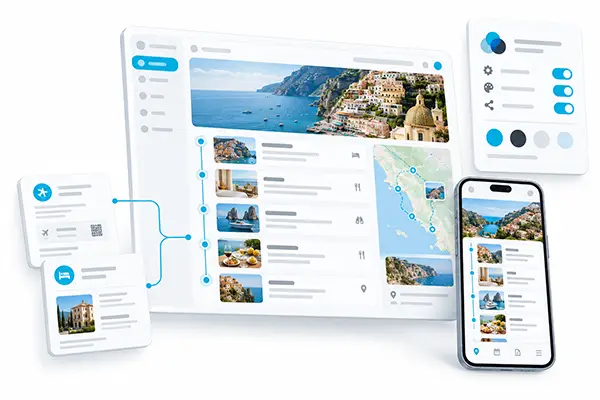
The right fit at a glance
Tools for your agency’s daily work
- Build and share itineraries.
Create a trip once, then deliver it through web, PDF and mobile app. - Less copying. More time for clients.
Connect booking systems and import supplier documents. - Start with what you need.
Start with itinerary tools and shared-app branding. Add integrations or a dedicated app when needed.
This comparison focuses on features available in mTrip and how Travefy addresses the same needs. It is not a complete inventory of either platform.
Everyday travel workflows
From booking details to a complete trip
Build itineraries with less repetition
Import booking emails and supplier documents with the AI Import Wizard. Use templates and reusable content to assemble trips, review the details and share the finished itinerary.
Keep trip information together
Deliver itineraries and travel documents through web, PDF and mobile app. Keep travelers informed with updates and messages, with downloaded app content available offline.
Start simply, grow at your pace
Small agency teams can start with Trip Agent and use their own logo and colors. Choose a fully white-label app, connect booking systems or add paid risk management when those features are useful to your business.
Learn more: white-label app · itinerary builder · travel documents · duty of care · API and integrations
Feature by feature
mTrip vs Travefy: feature comparison
Both platforms create and share itineraries. The differences are in how much you can configure, how booking data connects, and how you support travelers. Travefy Enterprise is included wherever its features change the comparison.
| Criterion | mTrip | Travefy |
|---|---|---|
| Built for | Small and mid-size agency teams, tour operators, DMCs, TMCs and MICE agencies, as well as larger travel companies. mTrip does not target solo independent advisors. | Independent advisors, agencies, tour operators and DMCs. Agency plans add shared content and team controls; Enterprise adds custom-branded apps and itinerary API functionality. [1] [2] |
| Itinerary builder and AI imports | Turn supported booking emails, PDFs, Word documents, Excel files and booking web pages into editable itineraries with the AI Import Wizard. Reuse templates and shared content, then review imported dates, names and booking details before sharing. | Drag-and-drop itinerary and proposal builder with AI Content Import, a reusable library and supplier-content integrations. Travefy documents more than 200 supplier integrations, including cruise and land-tour content. [3] |
| Delivery formats | Build once and deliver through a branded mobile app, web itinerary and PDF. Connected app and web views receive published changes. Regenerate and resend a PDF when an updated file is needed. | Share through online itineraries, PDF exports and the Trip Plans traveler app. Published trip changes update in the connected app; downloaded documents remain separate copies. [3] [4] |
| Offline access and destination content | Downloaded itineraries, travel documents, destination guides and maps remain available offline. Travelers can prepare the content before departure; messages, flight alerts and new itinerary changes require a connection. | Trip Plans and Enterprise traveler apps support downloaded trip access offline. The itinerary builder includes destination-guide content. The reviewed sources do not establish an equivalent downloadable offline-map feature. [3] [4] [2] |
| Branding and app ownership | Trip Agent applies your logo and colors inside a shared app. The fully white-label option provides a dedicated iOS and Android app with your name, icon and colors under your own developer accounts. The web itinerary can use your own domain. | Standard traveler delivery uses Trip Plans, which Travefy describes as deliberately unbranded. Enterprise offers custom-branded native iOS and Android apps, store listings, an app icon, domain masking and email masking. The reviewed page does not specify developer-account ownership. [4] [2] |
| App features and content customization | Switch individual traveler features on or off per account, such as the trip journal, tipping guide and tour leader tools. Configure content and branding for different programs or clients, with optional bespoke development for requirements beyond the standard controls. | Itinerary content is customizable, and messaging can be enabled or disabled for individual trips. Enterprise adds app branding. A comparable breadth of traveler-feature switches is not documented in the reviewed sources. [3] [5] [2] |
| Workflow customization and integrations | Adapt how bookings are imported, managed and delivered through Amadeus, Sabre and Travelport, mid-office connections including Tourplan, Moonstride, Ezus and Juniper, the mTrip API and Zapier. Optional custom integrations support specific workflows. Availability depends on plan and scope. | Supplier connections and AI imports support trip creation. Enterprise’s itinerary API can create itineraries from reservation or client-management systems and insert custom database content. Named native GDS connections are not documented in the reviewed sources. [3] [2] |
| Groups, teams and multiple brands | Build individual and group itineraries, reuse a shared content library and collaborate across your team. Multi-brand options allow distinct branding, traveler features and configurations for different programs. | Group-travel itineraries, shared templates and content libraries, plus Agency team controls. Enterprise supports a custom-branded app; management of multiple app brands from one back office is not specified in the reviewed sources. [3] [1] [2] |
| Traveler communication | Two-way in-app messaging, push notifications and live flight updates keep travelers connected to the agency. Messaging can connect with operational tools such as email, Zendesk, Missive or Genesys, depending on configuration. | Trip Plans includes client chat and flight notifications. Advisors can manage trips and chat through Travefy Pro. Messaging can be enabled or disabled per itinerary. [4] [5] |
| Risk management and disruptions | Optional paid risk management adds traveler tracking, risk alerts and a disruption dashboard. It combines itinerary information and risk intelligence so teams can identify affected travelers and coordinate communication. GPS location requires traveler opt-in. | Live flight updates are documented. A dedicated traveler-risk monitoring and duty-of-care dashboard is not documented in the reviewed sources. [4] |
| Getting started | Agency teams can begin with itinerary creation, supported document imports and Trip Agent shared-app branding. Booking integrations, a dedicated app and custom development are optional, so they do not need to be part of the initial setup. | Self-service access to the standard platform, with onboarding and support options by plan. Custom-branded apps and itinerary API automation are offered through Enterprise. [1] [2] |
| Custom development | mTrip’s in-house team offers optional bespoke features and integrations beyond standard configuration. A team can use the existing platform first and add custom work when there is a specific operational need. | Enterprise documents custom app branding and itinerary API integration. Broader bespoke product-feature development services are not documented in the reviewed sources. [2] |
| Traveler and agent portal languages | Traveler experience: English, French, German, Spanish, Italian, Portuguese, Dutch, Polish and Japanese.
Agent portal: The same nine languages, so teams and travelers can use their preferred supported language. |
Traveler experience: Additional interface languages are not confirmed for Trip Plans or Enterprise apps in the reviewed sources.
Agent portal: The help article describes Travefy as English-only and suggests browser translation. The article is dated November 2022 and remained available at this review; it is not a current version-specific language matrix. [6] |
Shared capabilities
Where both platforms deliver
Both mTrip and Travefy help travel professionals turn booking information into itineraries clients can use before and during their trip. AI imports, reusable content, mobile access and traveler communication are shared capabilities, rather than exclusive reasons to choose either platform.
Travefy’s supplier and cruise-content library is a practical strength for teams that frequently build those trips. Its Enterprise offering also provides custom-branded apps and itinerary automation through an API. Those capabilities matter when comparing like-for-like options.
mTrip’s case is the combination of configurable traveler features, named GDS and mid-office connections, multilingual interfaces and optional risk management. For agencies that need those capabilities together, mTrip is the stronger fit.
Your priorities
When mTrip is the better choice
mTrip: control over workflow, features and brand
Choose mTrip when your team wants to decide how booking data flows into itineraries, which features travelers see and how your brand appears across delivery channels. Named operational integrations, nine-language support and optional risk management extend the platform beyond creating and sharing the trip.
That flexibility is useful to small and mid-size agency teams as well as larger companies. Start with the existing tools, then add a dedicated app or custom integration when it solves a specific need.
Travefy: itinerary creation and supplier content
Travefy is a credible option when your priority is building proposals and itineraries with reusable content, supplier imports and Trip Plans delivery. Its cruise-content library and advisor mobile app can suit teams working heavily in those areas.
Enterprise adds custom-branded apps and itinerary API automation. Branding alone is therefore not the deciding difference; the depth of feature configuration, named operational connections and traveler services matters.
Moving over
Switching from Travefy to mTrip
Start with a representative itinerary and the booking confirmations behind it. Import supported emails, PDFs, Word documents or spreadsheets with mTrip’s AI Import Wizard, then check traveler names, dates, time zones, booking references and any missing information before sharing.
Build a reusable template for the trips your team creates most often. Review the web itinerary, PDF and mobile experience together so the content stays consistent across the formats your clients use. A downloaded PDF needs to be regenerated after a change.
Your team can begin with the standard platform and Trip Agent. GDS connections, a dedicated app and bespoke development are optional. Document imports do not transfer an entire Travefy account, saved library or historical conversations.
Questions agencies ask
mTrip vs Travefy: frequently asked questions
Is mTrip a good Travefy alternative for travel agencies?
Yes. mTrip is a strong Travefy alternative for agency teams that want itinerary building, branded delivery and traveler communication with more control over features and operational connections. Its documented strengths include configurable traveler features, named GDS and mid-office integrations, nine-language support and optional risk management. Travefy remains a credible option for itinerary creation and supplier content, including Enterprise branding and API options.
Does Travefy offer a white-label mobile app?
Yes. Travefy Enterprise offers custom-branded native iOS and Android apps, app-store listings, an app icon, domain masking and email masking. Standard delivery uses Trip Plans, which Travefy describes as deliberately unbranded. mTrip offers shared-app branding through Trip Agent or a dedicated app under the agency’s own developer accounts with its fully white-label option.
How does mTrip compare with Travefy Enterprise?
Both offer custom-branded apps and itinerary API capabilities. mTrip additionally documents individual traveler-feature controls, named GDS and mid-office connections, multiple-brand configurations and optional risk management. Travefy Enterprise documents automated itinerary creation from external systems and customized database content. The comparison therefore depends on the required workflow and feature scope, not just whether an app can carry a brand.
Can small agency teams use mTrip without custom development?
Yes. Small and mid-size agency teams can use mTrip’s itinerary builder, supported document imports and Trip Agent shared-app branding. A dedicated app, GDS integration and bespoke development are optional. mTrip serves agency teams rather than solo independent advisors.
Do mTrip and Travefy work offline?
Both support downloaded traveler itineraries and documents offline. mTrip also documents offline destination guides and maps. Travefy offers destination content in its builder, but the reviewed sources do not establish equivalent downloadable offline maps. Both need connectivity for new messages, live flight information and later itinerary updates.
Can I move existing Travefy itineraries into mTrip?
Supported booking confirmations and source documents can be imported using mTrip’s AI Import Wizard and reviewed as editable itineraries. Test representative files and check the resulting details. This process does not constitute a full Travefy account migration or automatically transfer its saved library and historical conversations.
Which languages do mTrip and Travefy support?
mTrip supports English, French, German, Spanish, Italian, Portuguese, Dutch, Polish and Japanese for both the traveler experience and agent portal. Travefy’s help article describes its workspace as English-only and suggests browser translation; the article is dated November 2022 and was still available at review. The reviewed sources do not provide a separate current language list for Trip Plans or Enterprise traveler apps.
About this comparison
Method and sources
Published by mTrip, one of the vendors compared. This page focuses on features available in mTrip and how Travefy addresses the same needs; it is not an exhaustive inventory or an independent product ranking. Official product pages and help articles were reviewed on September 14, 2026. Standard Travefy plans and Enterprise capabilities are distinguished where relevant.
The recommendations reflect documented capabilities, not hands-on benchmark results. “Not documented” does not establish that a feature is unavailable. mTrip’s nine-language coverage for both interfaces was confirmed by its CEO. The older Travefy language article is identified explicitly so readers can judge the strength of that evidence.
Sources for this comparison
Official sources reviewed September 14, 2026. Numbered references above refer to the entries below.
- Travefy Standard and Agency plan feature lists.
- Travefy Enterprise white-label apps and itinerary API.
- Travefy Itinerary builder, supplier imports, destination content and group travel.
- Travefy Trip Plans mobile app: branding, chat, flight notifications and offline access.
- Travefy Help Center: Disabling the Chat Feature.
- Travefy Help Center: Is Travefy available in other languages? Article dated November 28, 2022.
mTrip documentation: itinerary builder and imports, branding and traveler-feature configuration, GDS and API connections, and risk management.