
Find your fit
mTrip vs AXUS Travel App.
Compare itinerary building, collaboration and traveler delivery. mTrip is the stronger fit for agency teams that want detailed traveler-feature controls, multilingual interfaces and optional disruption and risk management alongside branded itineraries and connected booking workflows.
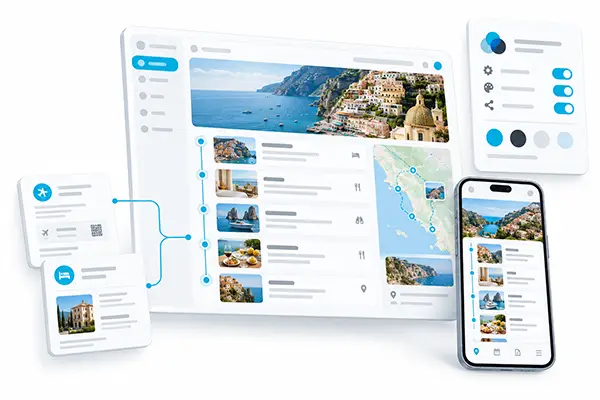
The right fit at a glance
Tools for your agency’s daily work
- Build and share itineraries.
Create a trip once, then deliver it through web, PDF and mobile app. - Less copying. More time for clients.
Connect booking systems and import supplier documents. - Start with what you need.
Start with itinerary tools and shared-app branding. Add integrations or a dedicated app when needed.
This comparison focuses on features available in mTrip and how AXUS addresses the same needs. It is not a complete inventory of either platform.
Everyday travel workflows
From booking details to a complete trip
Build itineraries with less repetition
Import booking emails and supplier documents with the AI Import Wizard. Use templates and reusable content to assemble trips, review the details and share the finished itinerary.
Keep trip information together
Deliver itineraries and travel documents through web, PDF and mobile app. Keep travelers informed with updates and messages, with downloaded app content available offline.
Start simply, grow at your pace
Small agency teams can start with Trip Agent and use their own logo and colors. Choose a fully white-label app, connect booking systems or add paid disruption and risk management when those features are useful to your business.
Learn more: white-label app · itinerary builder · travel documents · duty of care · API and integrations
Feature by feature
mTrip vs AXUS: feature comparison
Both platforms connect booking information, build itineraries and deliver them to travelers. AXUS also offers custom-branded apps and API services. The comparison below focuses on the scope of customization, operational connections and traveler support.
| Criterion | mTrip | AXUS Travel App |
|---|---|---|
| Built for | Small and mid-size agency teams, tour operators, DMCs, TMCs and MICE agencies, as well as larger travel companies. mTrip does not target solo independent advisors. | Travel advisors, agencies, DMCs and tour operators, with collaboration between travel planners and suppliers at the center of its itinerary workflow. [1] |
| Itinerary builder and AI imports | Turn supported booking emails, PDFs, Word documents, Excel files and booking web pages into editable itineraries with the AI Import Wizard. Reuse templates and shared content, then review imported dates, names and booking details before sharing. | Reusable itinerary content, hotel and flight lookup, cruise schedules, selected vendor imports and booking-email parsing through AwardWallet. General-purpose AI import from Word, Excel and PDF files is not documented on the reviewed product page. [1] |
| Delivery formats | Build once and deliver through a branded mobile app, web itinerary and PDF. Connected app and web views receive published changes. Regenerate and resend a PDF when an updated file is needed. | The AXUS traveler app, branded web itineraries and PDF output. Web views support proposals, trip samples and digital guides, with traveler notifications when published itineraries change. [1] |
| Offline access and destination content | Downloaded itineraries, travel documents, destination guides and maps remain available offline. Travelers can prepare the content before departure; messages, flight alerts and new itinerary changes require a connection. | The Android app listing confirms offline access to travel information. AXUS also documents destination guides and links to the phone’s map app. The reviewed sources do not specify the full offline document coverage or equivalent downloadable offline maps. [3] [1] |
| Branding and app ownership | Trip Agent applies your logo and colors inside a shared app. The fully white-label option provides a dedicated iOS and Android app with your name, icon and colors under your own developer accounts. The web itinerary can use your own domain. | The standard AXUS experience supports agency logos and branded itineraries. AXUS also offers custom-branded apps in the App Store and Google Play. Its public description does not specify developer-account ownership or the full configuration scope. [1] [2] |
| App features and content customization | Switch individual traveler features on or off per account, such as the trip journal, tipping guide and tour leader tools. Configure content and branding for different programs or clients, with optional bespoke development for requirements beyond the standard controls. | Custom reusable itinerary content, branded web views, advisor profiles and destination guides are documented. A comparable set of per-account switches for traveler-app features is not detailed in the reviewed sources. [1] [2] |
| Workflow customization and integrations | Adapt how bookings are imported, managed and delivered through Amadeus, Sabre and Travelport, mid-office connections including Tourplan, Moonstride, Ezus and Juniper, the mTrip API and Zapier. Optional custom integrations support specific workflows. Availability depends on plan and scope. | GDS PNR import, selected vendor imports, AwardWallet email parsing and existing system integrations are documented. Push and Pull API services can connect proprietary back-end systems. The reviewed overview does not list every supported GDS or connection. [1] [2] |
| Groups, teams and multiple brands | Build individual and group itineraries, reuse a shared content library and collaborate across your team. Multi-brand options allow distinct branding, traveler features and configurations for different programs. | A collaborator network lets advisors, DMCs and travel planners work on shared itineraries. Itinerary tasks, a calendar and reusable content support coordination. Multiple distinct app brands managed from one back office are not documented on the reviewed page. [1] |
| Traveler communication | Two-way in-app messaging, push notifications and live flight updates keep travelers connected to the agency. Messaging can connect with operational tools such as email, Zendesk, Missive or Genesys, depending on configuration. | In-app messaging, itinerary-change notifications and relevant flight notifications. Messages require an internet connection. Travelers can access advisor contact information and previously shared trips. [1] |
| Disruption and risk management | Optional paid disruption and risk management adds traveler tracking, risk alerts and a disruption dashboard. It combines itinerary information and risk intelligence so teams can identify affected travelers and coordinate communication. GPS location requires traveler opt-in. | Flight and itinerary-change notifications and travel-restriction information are documented. A dedicated traveler-risk monitoring and duty-of-care dashboard is not documented in the reviewed sources. [1] |
| Getting started | Agency teams can begin with itinerary creation, supported document imports and Trip Agent shared-app branding. Booking integrations, a dedicated app and custom development are optional, so they do not need to be part of the initial setup. | Online subscription access for itinerary building and traveler delivery. AXUS separately advertises custom-branded app services and API access. Its public page does not provide a detailed implementation timeline for these services. [1] [2] |
| Custom development | mTrip’s in-house team offers optional bespoke features and integrations beyond standard configuration. A team can use the existing platform first and add custom work when there is a specific operational need. | Custom-branded apps and Push and Pull API services are documented. Broader bespoke product-feature development beyond those services is not specified in the reviewed sources. [2] |
| Traveler and agent portal languages | Traveler experience: English, French, German, Spanish, Italian, Portuguese, Dutch, Polish and Japanese.
Agent portal: The same nine languages, so teams and travelers can use their preferred supported language. |
Traveler experience: Additional interface languages are not confirmed in the reviewed product page or Android listing.
Agent portal: Additional interface languages are not confirmed; the reviewed sources do not establish English-only support. [1] [3] |
Shared capabilities
Where both platforms deliver
Both mTrip and AXUS help travel professionals assemble itineraries, reuse content and deliver trip information through mobile, web and PDF. Both document booking-system connectivity, traveler messaging and custom-branded app options. Those capabilities should be compared by scope rather than treated as exclusive to one provider.
AXUS has a clear collaboration focus: its network allows travel advisors, DMCs and other planners to work together on an itinerary. Built-in booking lookups, reusable content, tasks and a shared itinerary calendar can suit teams coordinating closely with suppliers.
mTrip is the stronger fit when your requirements extend to detailed traveler-feature configuration, nine-language traveler and agent interfaces, named operational integrations and optional disruption and risk management. Those capabilities connect trip production with how your team serves travelers before departure and on the road.
Your priorities
When mTrip is the better choice
mTrip: control over workflow, features and brand
Choose mTrip when you want to decide how bookings enter your itineraries, which features travelers see and how your brand appears across delivery channels. Its documented feature controls, multilingual interfaces and optional disruption and risk management provide a broader set of options for supporting different client types and programs.
Small and mid-size agency teams can begin with itinerary tools and Trip Agent. A dedicated app, custom integrations and bespoke development are optional, so the platform can be configured around the needs you have today.
AXUS: collaboration across travel partners
AXUS is a credible option when shared itinerary production with advisors, DMCs and suppliers is central to your workflow. Its collaborator network, reusable library, booking lookups and itinerary tasks support that process.
AXUS also offers custom-branded apps, GDS PNR imports and API services. The deciding factor is the scope of feature configuration and traveler services you need, rather than whether the platform offers branding or integrations at all.
Moving over
Switching from AXUS to mTrip
Start with a representative itinerary and the booking confirmations behind it. Import supported emails, PDFs, Word documents or spreadsheets with mTrip’s AI Import Wizard, then check traveler names, dates, time zones, booking references and any missing information before sharing.
Build a reusable template for the trips your team creates most often. Review the web itinerary, PDF and mobile experience together so the content stays consistent across the formats your clients use. A downloaded PDF needs to be regenerated after a change.
Your team can begin with the standard platform and Trip Agent. GDS connections, a dedicated app and bespoke development are optional. Document imports do not transfer an entire AXUS account, saved library, collaboration history or historical conversations.
Questions agencies ask
mTrip vs AXUS Travel App: frequently asked questions
Is mTrip a good AXUS Travel App alternative?
Yes. mTrip is a strong AXUS alternative for agency teams that need itinerary building and branded delivery with detailed traveler-feature configuration, multilingual interfaces and optional disruption and risk management. AXUS is a credible option for shared itinerary production with travel advisors, DMCs and suppliers. The better fit depends on the required workflow and traveler-service scope.
Does AXUS offer a custom-branded mobile app?
Yes. AXUS advertises custom-branded apps in the App Store and Google Play, powered by its platform. Its public description does not specify developer-account ownership or the full feature-configuration scope. mTrip offers Trip Agent shared-app branding or a dedicated iOS and Android app under the agency’s own developer accounts with its fully white-label option.
How does mTrip compare with AXUS on workflow customization?
Both document booking imports and API connectivity. AXUS offers GDS PNR import, vendor imports, AwardWallet email parsing and Push and Pull API services. mTrip names Amadeus, Sabre, Travelport and several mid-office integrations, and provides its API, Zapier and optional custom development. mTrip also documents individual traveler-feature controls and multiple-brand configurations.
Can a small agency use mTrip without custom development?
Yes. Agency teams can start with the standard itinerary builder, supported document imports and Trip Agent shared-app branding. Booking-system connections, a dedicated app and custom development are optional. mTrip serves small and mid-size agency teams as well as larger travel organizations; it does not target solo independent advisors.
Do mTrip and AXUS work offline?
Both document offline traveler access. mTrip specifies downloaded itineraries, documents, destination guides and maps. AXUS’s Android listing confirms offline travel information, but the reviewed sources do not define the complete offline content coverage or equivalent downloadable maps. New messages, notifications and later changes need connectivity.
Can I move existing AXUS itineraries into mTrip?
mTrip’s AI Import Wizard can structure supported booking emails, PDFs, Word files and spreadsheets into editable itineraries. Start with representative source documents and check the imported details. Document imports do not automatically transfer an entire AXUS account, saved library, collaboration history or historical conversations.
Which languages do mTrip and AXUS support?
mTrip supports English, French, German, Spanish, Italian, Portuguese, Dutch, Polish and Japanese for both the traveler experience and agent portal. A supported AXUS interface-language list was not found in the accessible official product page and Android listing reviewed. This evidence gap does not establish that AXUS is English-only.
About this comparison
Method and sources
Published by mTrip, one of the vendors compared. This page focuses on features available in mTrip and how AXUS addresses the same needs; it is not an exhaustive inventory or an independent product ranking. Official product pages and the AXUS Android listing were reviewed on September 14, 2026. AXUS’s custom-branded app and API services are included where relevant.
The recommendations reflect documented capabilities, not hands-on benchmark results. “Not documented” does not establish that a feature is unavailable. AXUS support articles could not be accessed during this review, limiting verification of detailed settings and languages. mTrip’s nine-language coverage for both interfaces was confirmed by its CEO.
Sources for this comparison
Official sources reviewed September 14, 2026. Numbered references above refer to the entries below.
- AXUS platform overview: itinerary building, collaboration, booking imports, traveler features and web delivery.
- AXUS Custom Services: custom-branded apps and Push and Pull API access.
- AXUS Travel App, Google Play listing: offline access and traveler functionality; listing updated September 1, 2026.
mTrip documentation: itinerary builder and imports, branding and traveler-feature configuration, GDS and API connections, and disruption and risk management.