
Best app for corporate travelers · 2026 guide for TMCs
Best App for Corporate Travelers: 5 Options Compared for TMCs (2026)
Five ways to give corporate travelers an app, compared on branding, itinerary source, alerts, duty of care and launch effort.
This guide to the best app for corporate travelers covers TripIt, SAP Concur Travel, CheckMyTrip, an in-house build and a white-label platform. A corporate travel app puts a corporate or business traveler’s itinerary, flight alerts and support in one phone app during a business trip. A TMC can get one five ways: send travelers to TripIt or CheckMyTrip, rely on an online booking tool’s app such as SAP Concur, build its own, or publish a white-label app under its brand.
Updated October 8, 2026. Facts about the vendors come from their public sites, checked October 8, 2026.
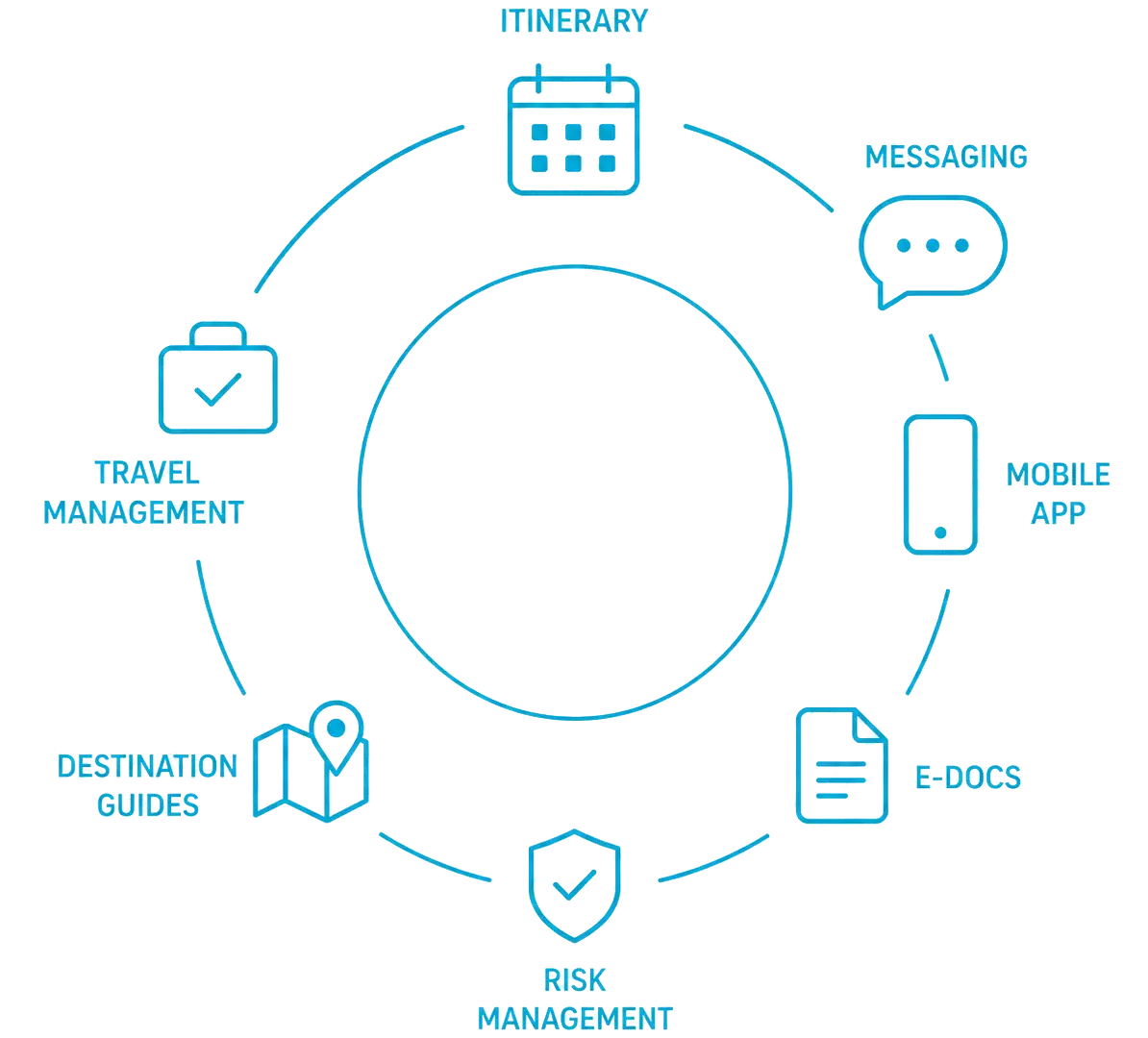
Which corporate travel app fits a TMC best?
A TMC that wants its own brand on the corporate or business traveler’s phone, with itineraries built from its booking data, needs a white-label platform such as mTrip. TripIt and CheckMyTrip serve individual travelers. SAP Concur Travel serves corporate clients that book and expense in one system. An in-house build suits TMCs with a funded development team.
Buying criteria
What a Corporate Travel App Should Do for a TMC
A corporate travel app means more than an itinerary viewer. It is judged by what happens when a client’s traveler lands, changes plans or loses signal. Six questions separate the five options.
Brand and data
- Carries your brand, not a vendor’s. Travelers open the app dozens of times per trip. Whose name sits on the icon decides whose service they credit when it goes well.
- Builds the itinerary from your booking data. Itineraries built from GDS, booking-tool and back-office records need no traveler action. Itineraries built from forwarded emails depend on every traveler remembering to forward.
- Fits each corporate client. One TMC serves many accounts. The app should take a client’s branding, modules, contact options and online booking tool without a new project.
In the traveler’s hands
- Warns travelers when plans change. Delays, gate changes and cancellations should reach the traveler and your support team at the same moment, across the whole trip, not only the flight.
- Works without a connection. The itinerary, documents and emergency contacts have to open offline, in the traveler’s language.
- Adds duty of care when the client needs it. Location and risk alerts should be switchable per client, with traveler consent, and should not force every account to pay for them.
At a glance
Best App for Corporate Travelers: Five Options Side by Side
Scroll sideways on smaller screens. Where a vendor’s public site does not say, the cell says so.
| Option | Built for | Brand on the app | Itinerary comes from | Flight and disruption alerts | Duty of care | Launch effort |
|---|---|---|---|---|---|---|
| mTrip | TMCs | Yours: logo and colors, or your own store listing | Any OBT (can differ per account), GDS, mid-office, plus email and document import | Flight alerts, delay predictions, messaging | Optional paid add-on | Same day (Trip Agent) or 2 to 3 weeks (white-label) |
| TripIt | Individual travelers | TripIt | Forwarded emails and supported booking sites | Real-time flight status; risk alerts on Pro | Not documented; individual risk alerts on Pro | Traveler signs up |
| SAP Concur Travel | Corporate clients booking and expensing in one system | SAP Concur | Bookings made in Concur, plus TMC and GDS connectors | Updates on schedule changes | Consolidated location and booking data | Not publicly documented |
| CheckMyTrip | Individual travelers | CheckMyTrip | Forwarded emails, booking number or manual entry | Delay and gate-change alerts | Not documented | Free, traveler self-serve |
| In-house build | TMCs with a funded development team | Fully yours | Whatever you integrate | You build it | You build it | 4 to 6 months for a medium app, then upkeep |
Option 1 of 5
mTrip: a white-label corporate travel app for TMCs
Best for: TMCs that want corporate travelers to see the TMC’s brand, with itineraries built from booking data instead of forwarded emails.
mTrip is a white-label platform. Your team builds or imports the itinerary, and mTrip delivers it as a branded mobile app, a web itinerary and a PDF, all kept in sync. There are two ways in. Trip Agent is a shared app in your logo and colors: you subscribe and send itineraries the same day. The white-label app is published under your own Apple and Google developer accounts, with your name and icon, and goes live in 2 to 3 weeks depending on integrations.
The itinerary comes from the systems you already run: Amadeus, Sabre and Travelport, mid-office platforms and online booking tools. mTrip can integrate with any OBT, and each corporate account can use a different one. Existing connections include Concur, Cytric and KDS. The AI Import Wizard reads emails, PDFs, Word and Excel files, and the Zapier connection covers the rest. Travelers get flight status with delay predictions, in-app messaging that can feed Zendesk, Missive or Genesys, and offline access in 9 languages.
Duty of care, with consent-based location tracking, is an optional paid add-on that you switch on per corporate client.
mTrip also does custom development for TMCs: new partner integrations and new features built to your requirements, on top of the standard platform. mTrip is priced by itinerary volume, not per agent seat, and security details sit in the Trust Center. mTrip is not a booking engine of its own. It integrates each account’s booking tool inside the app, so travelers book and manage the trip in one place.
Key strengths
- Your logo and colors, or your own store listing
- Integrates with any OBT, different per corporate account
- Itineraries built from GDS, OBT and mid-office data
- Flight alerts with delay predictions, in-app messaging
- Works offline, in 9 languages
- Duty of care as a per-client add-on
- Custom development for TMC partner integrations and features
Limitations
Not a booking engine of its own: it integrates each account’s booking tool inside the app. It is not built for TMCs that want to own and run the app code themselves. Pricing is quote-based with no public price list, and the white-label app carries a setup fee and a one-year engagement. Duty of care costs extra.
Option 2 of 5
TripIt for corporate travel: what a TMC needs to know
Best for: Individual travelers who organize their own trips. For a TMC, it is a tool its corporate clients’ travelers may already use alongside SAP Concur.
TripIt is a trip organizer from SAP Concur. A traveler forwards confirmation emails to TripIt, or links a supported booking site, and the app assembles a single itinerary. The free tier covers the basics. TripIt Pro, at $49 a year according to its site, adds seat and fare tracking, real-time flight status, alternate flights during disruption and risk alerts.
TripIt is quick to adopt because the traveler does the setup. That is also its limit for a TMC: every traveler sees TripIt’s brand, the trip depends on the traveler forwarding the right emails, and our check of its public site on September 16, 2026 found no admin portal for managing travelers, trips or branding. TripIt integrates with SAP Concur, so it fits companies already on that stack.
Key strengths
- Familiar to many business travelers
- No rollout: the traveler signs up and forwards emails
- Pro adds flight status, alternate flights and risk alerts
- Connects to SAP Concur
Limitations
One TripIt-branded app for every user, no white-label option, no admin portal for a TMC found on the public site. The itinerary relies on travelers forwarding emails.
Option 3 of 5
SAP Concur Travel as a corporate travel app
Best for: Corporate clients that want booking, policy enforcement and expense in one system, which a TMC often supports next to its own branded app.
SAP Concur Travel is an online booking platform. Travelers search and book flights, hotels, rail and rental cars, and the system flags options that break the travel policy. The SAP Concur mobile app gives access to bookings and itineraries, and travelers receive updates when a schedule changes. For duty of care, it consolidates traveler location and booking data so a company can respond in an emergency.
Concur’s reach is the strength: it lists more than 300 pre-built connectors to TMCs, GDSs, ERP platforms, airlines and hotels. The trade-off for a TMC is brand and role. The traveler’s app experience is shaped by SAP Concur’s product and identity, and a booking platform is a different tool from the branded itinerary a TMC delivers. Many TMCs run both. Pricing and launch effort are not publicly documented in a form we could verify.
Key strengths
- Booking, policy and expense in one system
- 300+ connectors to TMCs, GDSs and ERP platforms
- Real-time updates on schedule changes
- Traveler location and booking data for duty of care
Limitations
The app carries SAP Concur’s identity, not your TMC’s. It is a booking platform, so the itinerary experience is shaped by that product. Pricing and launch effort are not publicly documented.
Option 4 of 5
CheckMyTrip for corporate travelers
Best for: Individual travelers who want a free app for flight alerts and a single itinerary view.
CheckMyTrip is a free consumer app from Amadeus. Travelers forward confirmation emails, enter a booking number or add details by hand. The app sends real-time flight delay and gate-change alerts, check-in reminders and works offline. Its site cites more than 3 million travelers and a 4.6 out of 5 store rating.
As a corporate tool, CheckMyTrip stops short. It is one CheckMyTrip-branded app for every user. The public site documents no corporate customization, no admin portal and no duty of care module. For a TMC it works as something travelers may already have on their phone, not as the app the TMC delivers.
Key strengths
- Free for travelers
- Flight delay, gate-change and check-in alerts
- Three ways to import a trip
- Offline access
Limitations
One consumer-branded app. No white-label option, corporate customization, admin portal or duty of care documented on its public site.
Option 5 of 5
Building a corporate travel app in-house
Best for: TMCs that treat the traveler app as part of their core product, with a funded development team that will own it for years.
Building your own app gives full control over brand, data and every integration. Building in-house is also the main reason TMCs leave vendors, and AI coding tools make the first version look cheap. A medium-complexity travel app typically costs $50,000 to $120,000 and takes 4 to 6 months, and upkeep adds 15 to 25% of the build every year (Business of Apps, 2026).
The first version is the small part. Someone must secure the app, update it for every Apple and Google requirement, keep GDS and mid-office connections working, refresh destination content and support travelers when a trip breaks abroad. In Veracode’s Spring 2026 tests, 45% of AI coding tasks introduced a known security flaw, so AI-written code still needs expert review.
Key strengths
- Total control of brand and roadmap
- Your own data and integrations
- No vendor dependency
Limitations
$50,000 to $120,000+ to build, 15 to 25% of that each year to run, and 4 to 6 months before the first release. Security, store updates and support stay with you.
Decision framework
How to Choose the Best App for Your Corporate Travelers
Five questions to settle before any demo.
Whose brand should the traveler see?
If the answer is yours, TripIt, SAP Concur Travel and CheckMyTrip are out as the delivery app, because each carries its own name. That leaves a white-label platform or an in-house build.
Where does the itinerary come from?
Forwarded emails put the work on travelers. Booking data puts it on your systems once. If you already run a GDS, an online booking tool and a back office, choose the app that reads them.
Does the client need duty of care?
Some corporate programs require location and risk alerts, and some do not. Prefer a setup that lets you add it per client. The duty of care software checklist lists what to ask each vendor.
Do you also need to book and expense?
SAP Concur Travel and a white-label app do different jobs, so many TMCs run both: the booking tool sells the trip and the branded app delivers it. Pick the booking tool on its own merits.
Who will own the app in three years?
An in-house app is yours to secure, update and support for as long as it runs. A platform shares that load. Compare three-year cost, not first-release cost.
Is the best app for business travelers the best app for a TMC?
Not always. A business traveler choosing alone wants a free, fast organizer, which is where TripIt and CheckMyTrip fit. A TMC delivering trips for corporate clients needs its own brand, booking-data itineraries and per-client modules, which points to a white-label platform or an in-house build.
Weighing a shortlist? Send us the systems you run and the clients you serve. We will tell you where mTrip fits and where another option fits better.
What a white-label app adds
Why Add a White-Label App to Your TMC Offer
If your shortlist includes a white-label platform, these are the gains to test in a demo.
Keep your brand on the traveler’s phone
With a white-label app, the icon, the name in the store and every notification carry your TMC’s identity. mTrip publishes it under your own Apple and Google developer accounts, and each corporate client can have its own branding and modules. The branded mobile app page shows how it is configured.
Build itineraries from the systems you already run
mTrip reads Amadeus, Sabre and Travelport data and integrates with any online booking tool, so each corporate account can keep its own, whether that is Concur, Cytric, KDS or another. The AI Import Wizard, launched in February 2026, reads emails, PDFs, Word and Excel files for bookings that arrive outside a system. Our itinerary builder turns them into one day-by-day trip.
Reach travelers the moment plans change
Flight status and delay predictions reach the traveler by push notification, and in-app messaging can feed your support tool: Zendesk, Missive or Genesys. Documents, maps and guides open offline, and every itinerary stays in step across the app, the web itinerary and the PDF from document delivery.
Add duty of care client by client
The core app does not need it. When a corporate client’s policy asks for location tracking and risk alerts, you activate the module for that account, inside the same app the traveler already uses. See risk management for corporate travel.
Launch fast, then extend with custom development
Trip Agent works the day you subscribe. A fully white-label app takes 2 to 3 weeks. Both skip the 4 to 6 months of a first in-house release. When a client needs a partner integration or a feature the platform does not have, mTrip builds it as custom development for your TMC.
Use cases
Use Cases: Two Common Corporate Travel App Setups
A TMC serving several corporate clients
- Connects each client’s own booking tool, whichever it is, then delivers the trip in your branded app.
- Gives each corporate account its own look, contacts and modules, with custom development for partner integrations or features a client asks for.
- Switches duty of care on only for the clients whose policy asks for it.
A TMC launching its first branded traveler app
- Starts with Trip Agent the day it subscribes, then moves to its own store listing in 2 to 3 weeks.
- Keeps travelers informed during disruption without a manual email trail.
- Compares the platform’s three-year cost with the cost of building and running its own.
Questions about corporate travel apps
Frequently Asked Questions About Corporate Travel Apps
What is a corporate travel app?
A corporate travel app is a mobile app that holds a business traveler’s itinerary, flight alerts, documents and support contacts in one place during a trip. Some are consumer apps travelers choose themselves, such as TripIt. Some belong to a booking platform, such as SAP Concur Travel. Others are built in-house or published by a travel management company under its own brand.
Which option fits a TMC best?
A TMC that wants its own brand on the traveler’s phone and itineraries built from its booking data needs a white-label platform such as mTrip. TripIt and CheckMyTrip suit individual travelers who organize their own trips. SAP Concur Travel suits corporate clients that want booking, policy and expense in one system. An in-house build suits TMCs that fund a permanent development team.
What is the best app for business travelers?
It depends on who sets it up. A business traveler choosing alone can use TripIt or CheckMyTrip, which build a trip from forwarded confirmation emails. A traveler whose TMC supplies an app gets one built from booking data under the TMC’s brand, such as an mTrip white-label app. For a TMC, that second route is the one that carries its own brand.
What is the best app for managing business trips?
For one traveler, TripIt organizes a trip from forwarded confirmations. For a TMC managing trips for corporate clients, the best fit builds itineraries from booking data, alerts travelers when plans change, and adds messaging and duty of care per client. mTrip does this in one branded app and integrates each client’s booking tool.
What is the best app for travel managers?
Travel managers at a corporate client need visibility more than a personal organizer: who is traveling, what changed and who needs help. SAP Concur Travel offers that inside its booking platform. A TMC can give its clients’ travel managers a comparable view in its own branded app, with duty of care added for the clients that require it.
Can a TMC white-label TripIt or CheckMyTrip?
No. Both are consumer apps that carry their own brand for every user, and neither offers a white-label option or a TMC admin portal that we could find on their public sites on October 8, 2026. TMCs that want travelers to see their own name use a white-label platform. See our TripIt alternative for TMCs and CheckMyTrip alternative for TMCs.
Is SAP Concur Travel a corporate travel app?
Yes, with a different job. SAP Concur Travel is an online booking platform with a mobile app for bookings and itineraries, policy enforcement and expense links. It is not built to put a TMC’s brand on the traveler’s phone. TMCs often run it next to an itinerary app, and mTrip integrates with any online booking tool, including Concur, Cytric and KDS, even when each corporate account uses a different one.
Does a white-label app replace our online booking tool?
No. A white-label app such as mTrip takes bookings from your booking tool, GDS and back-office systems, and delivers them as one itinerary under your brand. mTrip can integrate with any online booking tool inside the app, and each corporate account can use a different one. Travelers still book where your clients’ policy sends them. The TMC software page lists the integrations.
Can mTrip be customized for a TMC’s partners and features?
Yes. mTrip does custom development for TMCs: new partner integrations, such as a client’s online booking tool or another system, and new features built to your requirements. Ask for it in a demo and describe the integration or feature you need.
How much does it cost to build a corporate travel app in-house?
A medium-complexity travel app typically costs $50,000 to $120,000 to build and takes 4 to 6 months, according to Business of Apps (2026). Upkeep then costs 15 to 25% of the build each year. Connections to GDS and mid-office systems push the cost to the upper end. Our build vs. buy guide shows the full breakdown.
How long does it take to launch a white-label corporate travel app?
With mTrip, the Trip Agent tier works the day you subscribe: you send itineraries in a shared app with your logo and colors. A fully white-label app, published under your own Apple and Google developer accounts, typically goes live in 2 to 3 weeks depending on integrations.
Do corporate travelers need duty of care in their app?
Only when the client’s travel policy requires it. Duty of care means knowing where travelers are and warning them about disruption or risk. Concur Travel consolidates traveler location and booking data for this purpose. With mTrip it is an optional paid add-on, activated per client, with consent-based location tracking. The duty of care software checklist helps you compare vendors.
Where does the itinerary in each app come from?
TripIt and CheckMyTrip build a trip from confirmation emails forwarded by the traveler, and CheckMyTrip also accepts a booking number or manual entry. SAP Concur Travel builds it from bookings made inside Concur. mTrip builds it from GDS, mid-office and back-office data, and its AI Import Wizard reads emails, PDFs, Word and Excel files. An in-house app takes whatever you connect.
Do corporate travel apps work offline?
It depends on the app. CheckMyTrip lists offline access on its site. mTrip’s app works fully offline, including documents, maps and destination guides. TripIt and SAP Concur do not state their offline scope on the public pages we checked, so ask for it in a demo before you commit. An in-house app works offline only if you build it that way.
Which languages do these apps support?
mTrip supports 9 languages: English, French, German, Spanish, Italian, Portuguese, Dutch, Polish and Japanese. The other vendors’ language lists are not stated on the public pages we checked, so confirm them against your clients’ traveler base.
How is this comparison different from a business travel app page?
This page compares five ways to equip corporate travelers. Our business travel app page describes one of them, mTrip, in detail. For other audiences, see the guides to the best travel agency apps and the best tour operator apps.