
2026 Buyer’s Guide
Best Tour Operator Apps in 2026: 5 Platforms Compared
Compare five tour operator apps on traveler communication, offline access, branding, and how they fit your operations.
A tour operator app does more than push an itinerary to a traveler’s phone. When it works properly, it is the operational thread connecting the back office, the supplier network, the selling agency, and the client — before the trip, throughout the journey, and after the traveler returns home.
In 2026, five platforms come up consistently: mTrip, Safari Portal, Vamoos, Travefy, and Wetu. They are not interchangeable, and the most useful starting point is a clear picture of what a well-built tour operator app should actually do.
Buying criteria
What the Best Tour Operator App Should Do in 2026
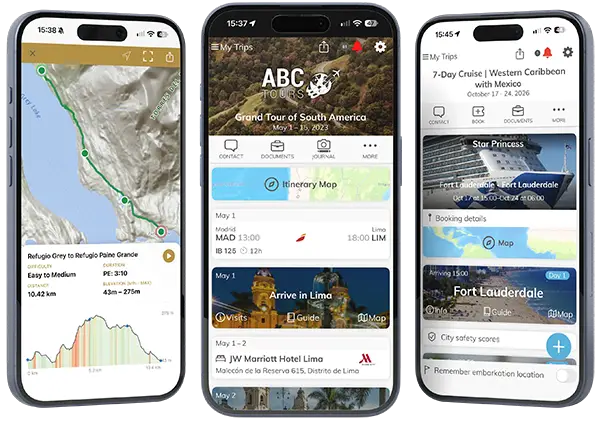
A complete platform sits at the intersection of three relationships: your team, your supplier and agency network, and your clients. The platforms that handle all three are in a different category from those that handle only one.
Reach across the whole operation
- Serve both B2B and B2C from the same platform. Tour operators work across two commercial layers at once. A platform that covers only the traveler-facing layer leaves B2B partners without tools. The complete picture requires both, built into one system rather than patched together from separate tools.
- Enable genuine supplier and agency collaboration. DMCs, guides, ground operators, and selling agencies should all contribute to, update, and communicate within the same trip file, without email chains, version conflicts, or parallel workflows that compound across every departure.
- Support rich in-trip communication across all layers. Two-way messaging between traveler and operator, group broadcasts, push notifications for schedule changes, and direct channels for internal coordination, all native to the platform. A phone number and a WhatsApp group are not a platform strategy.
- Publish under your brand in the App Store. Travelers search for your brand, download your app, and receive every notification from your brand, not a software vendor’s. An operator whose clients use a vendor-branded app is reinforcing that vendor’s brand relationship on every trip.
Fit the operation, work anywhere
- Be configurable to fit your specific workflow. The information shown to travelers, the fields visible to the operations team, the itinerary structure, and the notification logic should all be configurable to match how the specific business runs. A rigid tool forces your team to adapt to the software.
- Work fully offline for travelers in the field. International travel regularly places clients where mobile data is unavailable. Every element a traveler might need urgently, such as documents, accommodation details, guide contact, offline maps, and emergency numbers, must be accessible without a connection.
- Generate revenue beyond the original sale. Optional excursions, transfers, upgrades, and travel services should be surfaceable directly to travelers at relevant moments during the trip. This revenue currently flows to third-party consumer apps by default; recapturing it requires commercial tools built into the platform.
At a glance
The Top 5 Best Tour Operator Apps in 2026
Five platforms compared on B2B/B2C coverage, in-trip messaging, supplier collaboration, and customization. Scroll sideways on smaller screens.
| Platform | Best for | App Store white-label | B2B + B2C | In-trip messaging | Supplier collab | Customization |
|---|---|---|---|---|---|---|
| mTrip | Complete platform: B2B/B2C, comms, group tools, suppliers | Your brand | Both | Two-way + group | Strong | High |
| Safari Portal | High-end specialists: visual output, DMC collaboration | B2B option | Partial | In-app messaging | DMC sharing | Very high |
| Vamoos | Luxury boutique FIT: visual-first, pre/post-trip engagement | Premium tier | B2C only | Notifications only | Limited | Moderate |
| Travefy | Small operators & advisors: fast proposals, low barrier | Travefy brand | B2C only | Basic only | None | Moderate |
| Wetu | Pre-booking visual proposals; limited in-trip delivery | Wetu brand | Pre-booking only | Not included | Limited | Moderate |
Platform review · 1 of 5
mTrip
Best for: Tour operators of any size that need a complete platform covering white-label App Store publishing, B2B and B2C coverage, in-trip communication at every level, supplier and agency collaboration, and configurable workflows for any program type.
mTrip has been building tour operator technology since 2009 and serves more than 300 travel brands across 35 countries, managing over 4 million trips per year. The platform is used by operators ranging from independent boutique companies to large global brands including Globus, Collette, and AAA.
The most structurally distinctive aspect of mTrip is its dual B2B and B2C architecture. On the traveler side, clients access a fully branded mobile app published under the operator’s name in the App Store, not mTrip’s name. On the B2B side, selling agencies, host networks, and partner organizations can be given role-based access to client portfolios and live trip status within the same platform.
Communication built for every relationship in a live program
The communication layer covers every relationship involved in a live program. Travelers message their guide or operations team directly from the app. The operator can send targeted messages to individual travelers or broadcast to an entire group simultaneously. Tour leaders managing group departures have a dedicated module covering passenger manifests, real-time group member location visibility, and group-level communication, tools with no equivalent on any other platform in this comparison.
Trip Genius, mTrip’s AI recommendation engine, generates personalized daily activity suggestions based on confirmed bookings and traveler preferences. The AI Import Wizard, launched in February 2026, parses supplier confirmation emails and PDFs and converts them into structured itinerary content automatically.
Key strengths
- White-label App Store publishing under your brand
- Full B2B and B2C architecture in one platform
- Two-way messaging + dedicated tour leader module
- Role-based supplier and DMC collaboration
- AI tools: Trip Genius + AI Import Wizard (2026)
- 4.9/5 on G2 · Founded 2009
Limitations
Not built for a solo independent advisor working alone.
Platform review · 2 of 5
Safari Portal
Best for: High-end travel specialists globally, not just Africa, who prioritize exceptional visual itinerary output, deep layout customization, structured DMC collaboration, and in-platform messaging, with faster initial setup than more comprehensive platforms.
Despite the name, Safari Portal is a global platform serving high-end travel specialists across all destinations: South America, Asia, Europe, the Middle East, and beyond. It has won the World Travel Tech Awards Gold and the Travel Weekly Magellan Gold Award, and serves over 1,000 travel businesses internationally.
The platform’s clearest strength is the combination of visual output quality and workflow customization. Operators can apply their own brand fonts, custom itinerary layouts, and domain-branded URLs, so the finished product looks like something the agency designed, not a generic template. The content library is preloaded with thousands of property and area profiles, and operators can even apply their own CSS and layout modifications, an unusually high level of control for this category.
Safari Portal has moved well beyond pure itinerary production. In-app messaging between operators, travel advisors, and DMCs is now part of the platform. A Task Manager coordinates work across the team against active trips, Guest Portals give travelers a Travel Wallet for e-tickets and documents, a Tourplan integration is available for operators using that mid-office system, and the CRM includes a sales pipeline view across inquiry, confirmation, and archived status.
Key strengths
- Exceptional visual itinerary output, globally applicable
- Custom brand fonts, CSS, and domain-branded URLs
- In-app messaging and Task Manager
- DMC and supplier content sharing tools
- CRM with sales pipeline · Tourplan integration
- World Travel Tech Awards Gold winner
Limitations
No standard white-label consumer app published in the App Store under your brand. Group tour management tools, such as manifests, tour leader view, and group broadcast, are absent. B2B partner agency access at scale is less developed than mTrip.
Platform review · 3 of 5
Vamoos
Best for: Luxury and boutique FIT operators in the European market whose primary differentiator is the visual quality of the client presentation, and whose program mix does not involve group departures, agency distribution networks, or supplier collaboration requirements.
Vamoos is a UK-based platform that has built genuine loyalty among luxury boutique operators, particularly in the European leisure market. The platform’s visual output is strong: imagery-led itinerary presentations that look and feel premium. For operators whose brand promise is an elevated bespoke journey, and for whom the look of the trip document is part of the perceived value of the service, Vamoos delivers on that specific dimension consistently.
The platform includes pre-trip engagement tools that keep the operator’s brand visible to clients between booking and departure, and post-trip content designed to encourage rebooking. A white-label app option is available at higher pricing tiers, and offline access to itinerary and document content is standard.
The per-passenger pricing model is transparent and predictable for boutique operations with a modest number of high-value annual departures. For operators who scale trip volume, it grows linearly in cost, so operators expecting significant growth should model the cost trajectory before committing.
Key strengths
- Visually polished, imagery-led client presentations
- Pre-trip and post-trip in-app engagement content
- White-label app option at premium tier
- Offline access for itinerary and documents
- Strong track record in European luxury FIT market
Limitations
No B2B access layer for selling agencies or partner networks, and no supplier or DMC collaboration tools. In-trip communication is limited to push notifications, with no two-way messaging and no group tour management functionality. Per-passenger pricing scales linearly with volume.
Platform review · 4 of 5
Travefy
Best for: Small tour operators and independent travel advisors who need to produce polished client proposals quickly, manage basic CRM and invoicing from one tool, and are not yet at a scale that requires supplier collaboration, B2B partner access, or their own App Store brand.
Travefy is the most widely used platform in the US travel advisor market and was voted #1 itinerary builder in the 2025 Host Agency Reviews survey, with over 30,000 travel brands on the platform. Its reputation is built on one consistent strength: getting a professional-looking itinerary and proposal from concept to client delivery quickly. The workflow is fast, the destination content library is broad, and the bundled CRM, invoicing, and intake forms make it a practical starting point for advisors previously managing those functions across separate tools.
Travefy’s client-facing mobile app is multi-tenant: travelers download a Travefy-branded app and access their itinerary within it. The operator’s branding appears inside the experience, but the app name in the App Store belongs to Travefy.
The platform does not include supplier or DMC collaboration tools, no B2B partner access layer, and no group tour management functionality. It is strongest as a proposal and itinerary delivery tool for individual leisure traveler programs, and less well suited to operations involving complex multi-party programs, escorted group departures, or distribution through agency networks.
Key strengths
- Fast, polished proposal and itinerary builder
- Bundled CRM, invoicing, and intake forms
- Large destination content library
- Accessible pricing; low barrier to entry
- #1 itinerary builder, 2025 Host Agency Reviews · 30,000+ brands
Limitations
Travelers download a Travefy-branded app, not yours. No supplier or DMC collaboration tools, no B2B partner access layer, and no group tour management functionality. Not suited to multi-party programs, escorted departures, or agency network distribution.
Platform review · 5 of 5
Wetu
Best for: Operators who need a strong visual proposal and pre-booking tool to move prospects toward confirmation, and who manage in-trip delivery through a separate system or are comfortable with Wetu’s premium plan requirements for traveler app access.
Wetu is a southern Africa-based platform used primarily in the pre-booking and proposal phase of the client journey. Its visual storytelling tools help operators produce compelling trip presentations designed to inspire clients and support the sales process, and the output quality is generally well regarded among its user base for the discovery and inspiration phase.
The most important limitation to understand when evaluating Wetu as a tour operator app is that the traveler-facing mobile app is only available on premium subscription plans; it is not included as a standard feature. Operators who evaluate Wetu at the standard plan level may find that the in-trip delivery capability they assumed was included is behind an additional cost threshold.
Beyond the pricing structure, Wetu’s operational depth for live trip management is limited. There are no supplier collaboration tools, no structured in-trip communication, and no group tour management features. Wetu is strongest as a dedicated proposal tool alongside a separate delivery system, and weakest when expected to serve as the primary operational platform for managing live programs end-to-end.
Key strengths
- Visual storytelling tools for pre-booking proposals
- Image-forward content for destination and property showcases
- PDF and web delivery of proposals
- Established user base in the Africa specialist market
Limitations
Traveler app requires a premium subscription, not a standard feature. No supplier collaboration tools, no structured in-trip communication, and no group tour management. Weakest when expected to manage live programs end-to-end.
Decision framework
How to Choose the Best Tour Operator App for Your Business
Questions worth asking before any demo.
Do you serve both selling agencies and direct travelers?
If partner agencies need visibility into their clients’ live trips, or if you distribute through an agency network, the platform needs a B2B access layer alongside its traveler-facing tools. mTrip is the only platform on this list built with that dual architecture from the ground up. If all your travelers book directly and no agency partner needs platform access, this distinction is less relevant.
How many parties are involved in managing a live program?
Programs involving DMCs, ground operators, local guides, and selling agencies need structured, in-platform collaboration tools. mTrip and Safari Portal both support this; Vamoos, Travefy, and Wetu treat the itinerary as a single-party artifact. For complex multi-supplier programs, the collaboration question determines whether coordination happens inside the platform or in a parallel system of emails.
Do you run escorted group programs?
If tour leader coordination, group manifests, and group-level messaging are part of your operations, only mTrip on this list provides dedicated tools for those functions. No other platform in this comparison has built a tour leader module with real group management depth.
Is your priority visual output or operational coordination?
If the constraint is producing beautiful itineraries quickly, Safari Portal addresses that faster than mTrip and with greater visual customization. If the constraint is the overhead of managing multi-party live programs, mTrip’s operational depth is more relevant than output aesthetics. The two are not mutually exclusive, but they reflect different starting points for evaluation.
What does your operation look like in two years?
Platform migrations are disruptive. A tool that fits today but hits a ceiling at twice your current volume is a deferred problem. Evaluating fit against future state, not just current state, leads to better decisions than choosing what is easiest to assess today.
Not sure which category you’re in? Send us your shortlist and your program mix: group departures, DMC network, and expected volume. We’ll tell you honestly where mTrip fits and where it doesn’t.
Questions about tour operator apps
Frequently Asked Questions About the Best Tour Operator App
What is a tour operator app?
A tour operator app is a branded mobile application, published on iOS and Android, that tour operators provide to their clients as the single place to access their itinerary, travel documents, destination guides, offline maps, and real-time trip updates before, during, and after the journey. The best tour operator apps in 2026 go beyond document delivery: they publish under the operator’s own brand name in the App Store, support two-way in-trip communication, enable supplier and DMC collaboration within the same platform, work fully offline for international travel, and in some cases provide dedicated tools for group departures and tour leader coordination.
What is the difference between a white-label tour operator app and a shared app?
A white-label tour operator app is published in the Apple App Store and Google Play under the operator’s own company name. Travelers search for the operator’s brand, download their app, and see only the operator’s identity throughout the experience. A shared or multi-tenant app, such as Travefy’s app, is a single platform where all operators’ clients download a common application that carries the technology provider’s name, with each operator’s content visible inside it. The white-label model means the operator owns the App Store relationship with their clients; the multi-tenant model means the technology provider does.
Is Safari Portal only for Africa-based tour operators?
No. Safari Portal explicitly states that it is not just for safaris and serves high-end travel specialists globally across all destinations. The platform’s content library includes properties and area profiles worldwide, covering South America, Asia, Europe, the Middle East, and beyond. It has won international travel technology awards and has over 1,000 users across global markets. The name reflects the platform’s origin story, not its current market scope.
Which tour operator app is best for managing supplier and DMC collaboration?
mTrip and Safari Portal are the two platforms on this list with the most developed supplier collaboration capabilities, though they approach it differently. Safari Portal gives DMCs and suppliers the ability to contribute content and itinerary sections directly within the platform, with in-app messaging connecting all contributors. mTrip provides role-based access across the full trip lifecycle: guides, ground operators, selling agencies, and DMCs each see and work on what is relevant to their role, with structured communication channels. For operators whose primary need is proposal-stage DMC co-building, Safari Portal’s tools are well suited. For operators managing live programs with multiple contributing parties, mTrip’s full operational architecture is more comprehensive.
Which tour operator app is best for escorted group tours and tour leaders?
mTrip is the only platform on this list with a dedicated Tour Leader module for escorted and group tour operations. Tour leaders get access to passenger manifests, real-time visibility into group member locations, and tools to communicate with the full group or individual travelers simultaneously. Safari Portal, Vamoos, Travefy, and Wetu do not offer comparable group operations functionality.
Do tour operator apps need to work offline?
Yes, for most operators. International travel regularly involves situations where mobile data is unavailable: remote wildlife reserves, long-haul flights, offshore cruising, high-altitude treks. Full offline access means travelers can open every element of their app, such as itinerary, documents, offline maps, destination guides, and emergency contacts, without an internet connection. mTrip and Safari Portal both offer full offline functionality as standard. Vamoos includes offline access for itinerary and document content. Travefy’s offline capability is partial. Wetu’s traveler app offline access depends on the subscription plan.
How do tour operator apps handle real-time flight updates?
The best platforms connect to live flight data APIs and push notifications to the traveler’s phone automatically when a flight is delayed, rescheduled, or the gate changes, without requiring the operator to manually monitor each departure. mTrip includes automatic real-time flight alerts as a standard feature. Safari Portal includes live flight update notifications and allows operators to opt into automatic itinerary updates when flight times change. Vamoos includes flight update functionality. Travefy has basic flight tracking. Wetu’s capabilities vary by subscription tier.
Can a small tour operator use these platforms, or are they only for large companies?
Every platform reviewed here serves operators across a range of sizes, though each has a different sweet spot. Travefy is designed from the ground up for independent advisors and small operations. Safari Portal has a 14-day free trial and tiered plans for smaller operators. Vamoos uses a per-passenger pricing model that can be cost-effective at low volumes. mTrip serves operators of all sizes, from independent boutique operators to enterprise clients like Globus and Collette, and its configuration depth means it can be implemented at a scope that matches the actual operation. Wetu is accessible to smaller operators through its standard subscription tiers.